


Great news for all dollar and euro holders! We again accept dollars (old and new), as well as euros of all denominations.
Cash pickup and dropoff points are conveniently located throughout Moscow. You can schedule an exchange or get any advice from our cash manager on Telegram. Cash pickup and dropoff point hours: daily from 10:00 AM to 10:00 PM Moscow time.
Exchange for cash is as follows:
- You create an exchange request on our website
- Next, we contact you on Telegram
- We will arrange a time for your arrival at the office
- You arrive at the office and we will make the exchange
Popular USD cash exchange options:
Popular cash EUR exchange directions:
We’ve covered most of the cash exchange questions in our FAQ.
How to distinguish old and new dollar bills
The main differences between old and new dollar bills are their appearance Design, color scheme, and security features. The new generation of banknotes are often referred to as “blue” bills, primarily due to the blue security stripe that appeared on the $100 bill in 2013.
The design updаte began earlier: the $20 bill received a new look in 2003, the $10 bill in 2004, and the remaining denominations in subsequent years. Everything issued before this period (in the previous green and white design) is considered to be old dollars.
Color scheme
Old banknotes are classic green and white, appearing monochromatic. New banknotes feature more saturated hues, including blue, orange, and purple, depending on the denomination. This makes them brighter and more noticeable.
Portraits
On old banknotes, the portraits are framed in oval frames and appear smaller. The new design removes borders, and the images are larger and more prominent—this applies to all banknotes with denominations of $5 and above.
Pattern and Design
In the old design, background elements were simple—mostly geometric patterns. The new banknotes feature a more complex background featuring historical US symbols. For example, a quill and inkwell appeared on the $100 bill, and the Statue of Liberty’s torch appeared on the $10 bill.

The 1929 $10 Bill —Old Style

2005 $10 Bill — New Design
Back:
Previously, the denominations on the back were in subdued tones, but now they are highlighted in color: for example, the “10” on the ten-dollar bill is orange, and the “5” on the five-dollar bill is purple.
Serial Numbers and Year of Issue
On bills issued before 1996, the serial number consists of two letters and eight digits. A ninth digit was added after the updаte. The year of issue is indicated on the front of the note, but it can also be determined by the first letter of the series—a correspondence table is published on the US Federal Reserve website.
The newest series are Q, P, and N, issued in 2017 and 2021. Older banknotes always have green serial numbers, while newer ones may have black ones. For example, in 2006, series with the letters H, I, K appeared, in 2009 – J, L, and in 2013 – M.

20 dollars new design
Material
Both old and new dollar bills are made from a blend of cotton and linen. However, modern banknotes are more wear-resistant thanks to improved production technology. The size of the bills remains the same: 156 x 66.3 mm. The size of the bills remains the same: 156 x 66.3 mm..
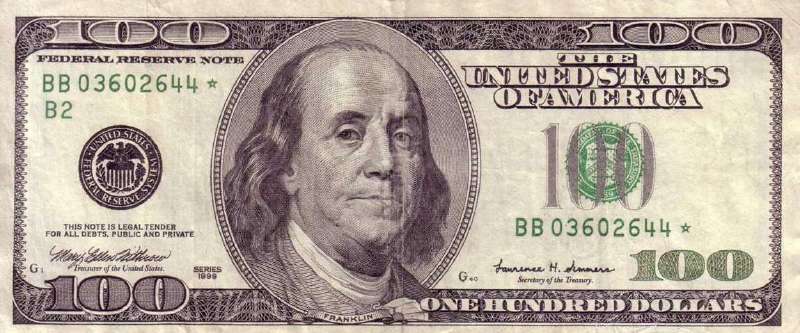
$100 Old (1999)

$100 New (2009)
Security Features
The main difference of the new dollars is enhanced security.
- The $100 bill now features a 3D blue ribbon.The bill also features a 3D blue ribbon.
- All new banknotes contain 3D security threads and a clearer watermark (on bills (produced before 1996, it was not there at all).
- Ink that changes color when tilted appeared, as well as more pronounced relief printing.
- The new design added microtexts with the inscriptions USA and United States of America – previously they were only on the front side and not so detailed.
- In addition, modern banknotes contain more security fibersthan older ones.
- Thus,